
When Fairness Eats Itself, Be Vigilant
What Karl Marx, Mao’s China, and the New Wealth Tax Bills Have in Common

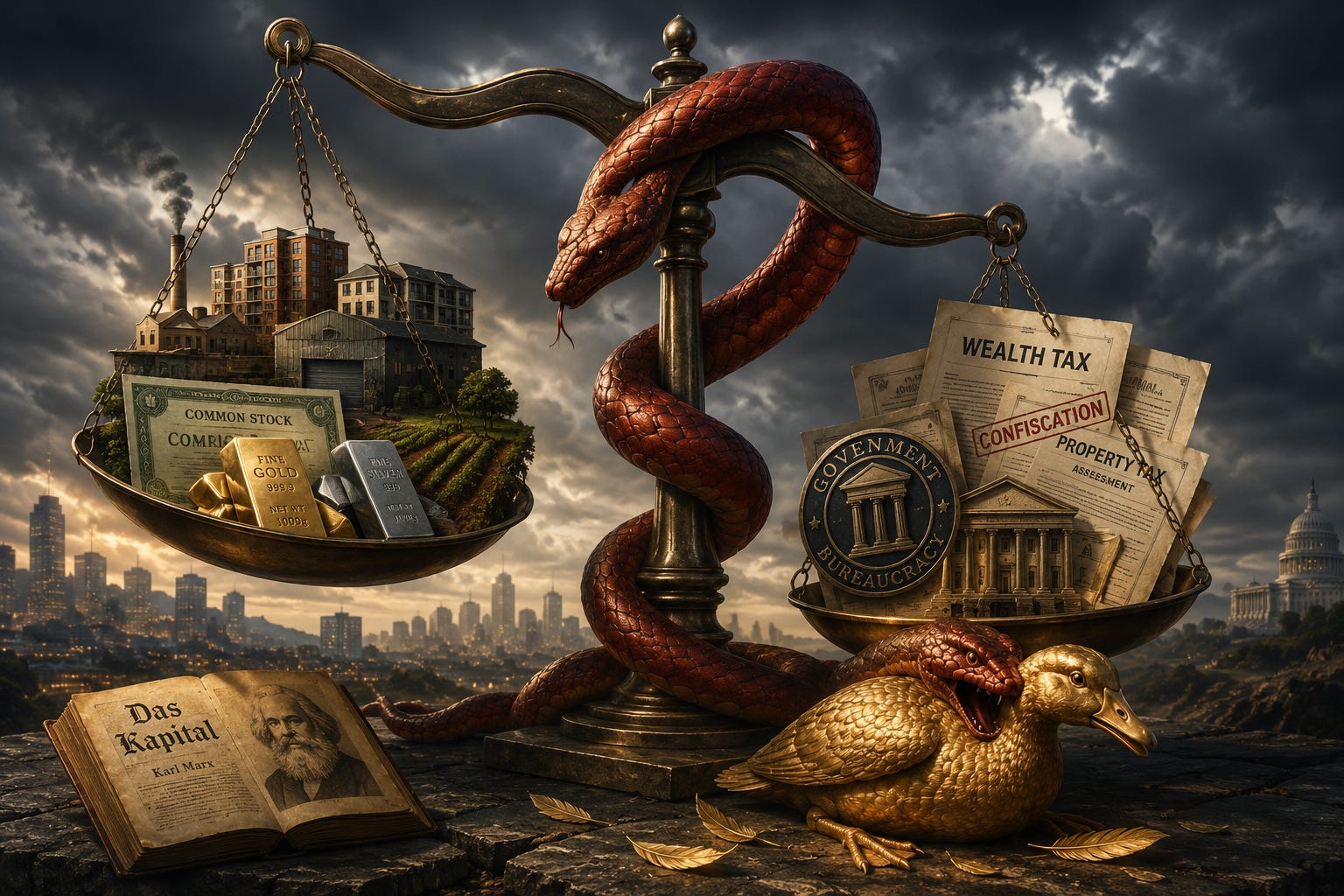
I watched a video from the economist Andreas Beck a few days ago, and it stopped me cold.
I’ve been sitting with it since, turning it over, and it eventually got me on a call with my research team to work through the history behind it, because once you see the idea Beck laid out, you cannot unsee it every time you hear the word “fairness” attached to an economic policy.
Marx’s core claim in his book “Das Kapital” was simple and, on its face, sympathetic.
A company’s profit, he argued, is not created by the owner. It is created by the labor of the workers. The owner simply captures the difference between what workers produce and what they’re paid, and calls it profit.
In Marx’s language, that gap is surplus value, and taking it is theft from the laborers.
Follow that logic all the way to its conclusion, and you arrive somewhere very specific:
If profit is theft, then private ownership of a company is the mechanism of theft, and the only fair economy is one where nobody privately owns the means of production at all.
That is not a fringe reading of Marx. It is Marx, stated plainly. And it matters right now because you can watch American politics rediscovering that exact logic in real time, dressed in the language of fairness rather than the language of class struggle.
Look at what’s actually sitting in Congress this year.
Senator Elizabeth Warren, Representative Pramila Jayapal, and more than forty-five cosponsors reintroduced the Ultra-Millionaire Tax Act in March, a 2 percent annual tax on net worth above $50 million, with an extra 1 percent on billionaires. Bernie Sanders and Ro Khanna introduced a separate bill the same month, a 5 percent annual wealth tax on the roughly 938 Americans worth over a billion dollars.
None of these bills taxes income. They tax ownership itself, the value of the business or the stock you hold, whether or not you sold anything or earned a dollar that year.
Here’s the thing worth understanding before you dismiss any of this as a distant federal proposal that may never pass.
It isn’t step one.
In several states, it’s already several steps in, and you can watch the consequences unfold in real time rather than model them theoretically. California has a 2026 Billionaire Tax Act headed for the November ballot, a one-time 5 percent tax on net worth over a billion dollars, retroactive to January 1, 2026, before voters have even cast a ballot on it.
Los Angeles already passed its own version in miniature back in 2022, a “mansion tax” on property sales, sold to voters as something that would only touch the wealthy. In practice it applies to any commercial, industrial, or multifamily property sale above roughly $5 million, mansion or not, and UCLA and RAND researchers found it cut high-value property sales by roughly half and is now costing the city more in lost future property tax revenue than it raises, by some estimates for every dollar it brings in the region loses over a dollar in future property tax.
That’s what happens when you tax a transaction instead of letting the market clear it. And this is Washington state’s money too, all of it: state income tax, capital gains tax, a payroll tax stacked on top in Seattle, a wealth tax on financial assets that has now stalled in committee two years running but keeps coming back, in a state that had no income tax and no capital gains tax at all as recently as 2021.
The response isn’t hypothetical either. It’s already happening at scale, and it’s documented, not speculation. Larry Page and Sergey Brin, Google’s founders, both moved assets and residency out of California ahead of the January 1, 2026, deadline tied to the billionaire tax. Peter Thiel opened a Miami office and shifted his public residency to Florida. Mark Zuckerberg, Larry Ellison, and former Starbucks CEO Howard Schultz have all bought property in Florida in the past year, several of them a few doors down from each other in the same gated compound.
One journalist who surveyed twenty-one California billionaires found twenty of them either already relocating or actively preparing to, representing over a trillion dollars in combined net worth and more than 50,000 jobs. Elon Musk moved Tesla’s and X’s headquarters out of California to Texas outright, calling a state policy decision “the final straw.” Los Angeles County lost over 54,000 residents in a single year.
This isn’t a warning about what could happen if a federal wealth tax passes someday. It’s a live case study of what happens once the principle that ownership itself can be taxed away becomes normal enough to build a state budget around.
One quote from that group deserves to sit at the center of this piece rather than the edge of it. Sergey Brin, responding publicly to California’s proposed billionaire tax, wrote plainly:
“I fled socialism with my family in 1979 and know the devastating, oppressive society it created in the Soviet Union.”
Brin isn’t speaking from theory. He lived the thing Beck is describing, and he’s telling you, directly, that he recognizes the shape of it again.
Run the math on what the federal version actually does over time. The economists who built the models for the Sanders bill, Emmanuel Saez and Gabriel Zucman, calculated that if a 5 percent annual wealth tax had applied since Jeff Bezos and Mark Zuckerberg became billionaires, Bezos would be worth $61 billion today instead of $244 billion, and Zuckerberg $90 billion instead of $227 billion.
I’d add one caveat: their model doesn’t fully capture. Their projection assumes share prices hold roughly steady while the tax is paid. But Bezos and Zuckerberg’s wealth is almost entirely in stock, not cash, so paying an annual 5 percent tax means selling a meaningful slice of that stock every single year, forever.
The real trajectory of a permanent annual sell-down is very likely worse than the static model shows, and it doesn’t stop with the founder.
Every other shareholder in that company, every retail investor with shares of Amazon or Meta in a 401k, a brokerage account, or an index fund, gets hit by the same falling price, without ever owing the tax themselves. That’s the part the fairness language conveniently skips over.
Marx called the gap between what a worker produces and what he’s paid theft.
Nobody sponsoring these bills would use that word for what an annual claim on someone’s unsold ownership actually does, but strip away the label and it’s the same mechanism working in the same direction, value taken from an owner without a sale, without an income event, without the owner’s consent, simply because the state has decided the amount they hold is no longer fair to keep.
Call it a wealth tax, and it sounds like justice.
Call it what it is, a government taking a slice of what you own every year, whether you sold anything or not, and it sounds like what it would be called anywhere else.
And once that kind of tax is on the books, it doesn’t just discourage founders from staying. It gives every investor, small or large, a real reason to look for exposure to companies incorporated somewhere this mechanism doesn’t reach, businesses built and owned in countries where an annual government claim on the value of what you built, sold or not, isn’t the starting assumption.
A tax pitched as something that only touches a few hundred billionaires ends up quietly taking a piece of the retirement account of everyone who owns stock in the companies those billionaires, who often started in a garage or an apartment converted to a first office, built.
Here’s where it gets almost too on the nose to believe, and I promise I am not making this up.
When Deng Xiaoping began reintroducing private enterprise into Communist China in the late 1970s, ending the most catastrophic economic experiment in modern history, his government had to decide how large a private business was allowed to get before it counted as exploitation. They didn’t guess. They went back to Marx’s own writing, where he’d observed that hiring more than roughly eight employees was the threshold at which an owner stopped working alongside his labor and started living off it.
So the Chinese Communist Party, rebuilding capitalism inside a communist state, capped private businesses at eight employees, because that was the number their own founding theorist had used to define the line between honest work and theft. Even the party that still calls itself communist had to write Marx’s theory of exploitation into law the moment it let capitalism back in the door.
Because they needed capitalism to survive.
This is the part of the story I think gets skipped, and it’s the part that matters most for you.
China was not always the world’s factory floor or a rising superpower. For most of the last two thousand years, China was the most advanced civilization on earth, ahead of Europe in metallurgy, printing, administration, and wealth.
Then, starting around 1875, something broke. That year, the Tongzhi Emperor died, and with him died China’s last serious attempt at self-directed reform, the Self-Strengthening Movement, an effort to modernize the empire’s military and industry while keeping its old political structure intact. In that same window, Japan’s Meiji Restoration was just getting started.
Within twenty years, the gap was undeniable: Japan had roughly 7,600 modern factories, China fewer than 300, and Japan proved the point by defeating China outright in the war of 1894-95. China had chosen stagnation. Japan had chosen reform. The divergence is locked in.
What followed was not a quick collapse but a century-long unraveling, and the worst of it came not from foreign powers but from Beijing’s own economic choices once the Communist Party took power in 1949.
Mao’s Great Leap Forward, an attempt to collectivize agriculture and force rapid industrialization by decree, produced the deadliest famine in recorded history, killing an estimated 16.5 to 45 million people between 1958 and 1961. The Cultural Revolution that followed spent another decade destroying what institutional capacity remained.
By 1978, after roughly a century of imperial stagnation followed by three decades of full socialist central planning, China’s economy was smaller relative to the world than it had been in 1875, an almost unimaginable outcome for a civilization that had spent most of human history as the wealthiest place on earth.
Then Deng Xiaoping did something the party has never fully admitted out loud, and this is the sentence I want you to sit with.
A government that still calls itself Communist looked at a century of decline, most of it self-inflicted through its own socialist experiment, and concluded that the only way back to power and prosperity was to reintroduce private ownership, profit, and markets, even while keeping every lever of political control firmly in the party’s hands.
“Black cat, white cat,” Deng said, “what does it matter what color the cat is as long as it catches mice.”
China’s GDP went from $150 billion in 1978 to $18.7 trillion by 2024. Average annual growth exceeded 9 percent for thirty-five straight years. The men who still run a nominally communist state understood something their own economic theory told them to deny: an economy needs private ownership and profit to function, full stop, and no amount of ideological commitment to the alternative changes that arithmetic.
If China shows you what a century of the wrong economic model costs a civilization, Cambodia shows you what happens when someone tries to get there in a single move instead of gradually.
In April 1975, the Khmer Rouge took Phnom Penh and declared what they called Year Zero. Within days, they abolished money entirely, burned the currency, blew up the national bank, eliminated private property outright, and marched the entire urban population into forced agricultural labor.
This was the logic Marx and Mao gestured toward, taken to its complete and literal conclusion, with no private ownership of anything left standing anywhere. In under four years, an estimated 1.5 to 2 million people died, close to a quarter of Cambodia’s population, the highest proportion of any country’s own citizens killed by its own government in the twentieth century.
There’s a phrase that came out of Germany after the Second World War,
“Wehret den Anfängen,”
resist the beginnings. Germans coined it for a specific reason: the individual steps that built the catastrophe they’d just lived through had each looked small, reasonable, and lawful at the time they were taken.
Nobody votes for catastrophe in one motion. They accept a series of steps that each seems defensible in isolation, and by the time the cumulative direction is obvious, the mechanism is already too entrenched to reverse.
That’s the warning worth carrying into this conversation.
I don’t believe the sponsors of these bills want what Mao or the Khmer Rouge built. But look at where the principle has already gotten a running start:
California retroactively taxes wealth before voters even approve it,
Los Angeles is taxing property transactions so heavily that it now loses more in future revenue than it collects,
Washington going from no income tax at all to two major new taxes in five years, with a third one waiting in the wings.
Twenty of California’s own billionaires are already voting with their moving trucks.
This isn’t the theoretical first step of a slippery slope. In these places, it’s already a well-worn path, and the people with the most at stake are the ones reading the direction most clearly and leaving before it closes behind them.
History doesn’t offer a single example, not one, of a society that eroded private ownership of productive capital and produced more prosperity for ordinary people as a result.
It offers Venezuela, the Soviet Union, Sergey Brin fled, Mao’s China, and Cambodia. It offers, on the other side of the ledger, every instance of a society reintroducing or protecting private ownership and watching living standards climb, China’s own reversal being the most dramatic example in human history.
This is exactly why I keep coming back, article after article, to owning productive assets directly, real estate that generates income, businesses that create value people freely pay for, capital you control rather than capital sitting exposed to whatever the political mood decides is fair this decade.
Own a diversified portfolio of productive assets, and let a portion of it sit outside the reach of any single government’s next reinvention of what counts as fair.
Marx called profit theft and built a theory around correcting it. History shows the correction was never anything but theft, with better branding, dressed in the language of justice each time it was tried, and it never once left the people it claimed to help better off.
The theory of who profits belongs to has been tested at the civilizational scale more than once. It only ever ends one way.
Own the asset, spread where you own it, and don’t wait for the beginning to become the end before you act on what history has already shown you.
This article is for informational and educational purposes only and does not constitute investment, legal, or tax advice. Nothing here should be construed as a recommendation to buy, sell, or hold any security or asset, or to take any particular legal or tax position. Political and legislative developments referenced are current as of publication and may change. Please consult a qualified financial advisor, attorney, or tax professional before making decisions based on this content.